
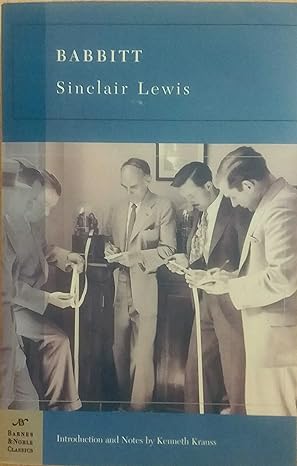
Babbitt book by Sinclair Lewis(Barnes & Noble Classics Series)
Babbitt book by Sinclair Lewis(Barnes & Noble Classics Series
In his novel Babbitt, Sinclair Lewis took a close look at what America was fast becoming and described it in clear, often damningly accurate and hilarious detail. In the 1920s, when readers first encountered the novel, they glimpsed new trends and tendencies that were going on all around them; we, as readers, today are in the curious position of witnessing just when and how the world as we know it—the world that we see virtually everywhere and that we tend to take for granted—came into being.
The hero, or at least main character, of the book is hardly unusual. He is distinguished by neither intelligence nor stupidity, bravery nor cowardice, kindness nor cruelty. Although he manages to demonstrate all of these characteristics, none of them can quite characterize him. In fact, George F. Babbitt is most interesting because he is not interesting, because he manages to locate himself between the extremes, positioning himself resolutely in the middle. He is, to put it simply, a middle-class, middle-brow, middle-aged, middle-American male who is about to embark on a midlife crisis. As a resident of the middle-sized Midwestern city of Zenith in 1920, he is poised on the brink of a great boom in the American economy and all the daring social changes that came along with it.
Yet as a person of some (although it must be stressed, just some) feeling, moral conscience, and spiritual belief, he is also heir to the terrible disillusionment that followed the Great War (World War I), which, in fact, is directly mentioned only once in the book. Babbitt may not have participated in the “war to end all wars,” but his experience of his world makes clear in subtle ways just how America was struggling to redefine and, at the same time, to remain itself after the cataclysm. Babbitt, who was (and probably still is) regarded by many as a (if not the) quintessential American type, stands at the center of a culture that, to borrow from Charles de Gaulle, had gone from barbarism to decadence without the usual intervening phase of civilization.
George F. Babbitt may not be a very likeable character, but he is difficult to hate completely. Ultimately, like some, but not all, of the people who inhabit Sinclair Lewis’s fiction, he makes his peace with his times by choosing to go along with them and with all that he has previously questioned. The notion of conformism, which Babbitt at times praises and at other times ridicules, plays a powerful role in the way he lives his life. One may not wish to be exactly like everyone else, but at the same time, one cannot afford to be too different. The pressure of others is inescapable in the end.
Nevertheless, perhaps his very lack of anything outstanding, whether for good or ill, makes Babbitt a genuinely outstanding modernist creation. Babbitt functions in literature as most people appear to function in life: He blends in, goes along, tries to uphold what is generally thought to be best for himself and perhaps his family and, at the same time, strives to make a buck. This blend of business not with pleasure but with what is supposed to be decency (which is never much fun) is an uneasy one. During the course of the narrative, Babbitt strays, questions his own misgivings, looks to end his own unhappiness, and rebels. In the end, he makes amends. Unwilling to accept the peril that comes with rebellion, Babbitt cautiously, but gratefully, interjects himself back into the social matrix that he has come so close to despising. He is saved at the expense of being lost.
Book Specifications
Book Title
You are viewing an alternative format/edition for this title. You can proceed directly to this book's page to complete your purchase.
More Books By Sinclair Lewis

Babbitt book by Sinclair Lewis(Barnes & Noble Classics Series)
People who bought this also bought
Giving: How Each of Us Can Change the World book by Bill Clinton
The Nine: Inside the Secret World of the Supreme Court book by Jeffrey Toobin
The Resurrection: Experience life in the risen Christ book by Fabrice Hadjadj
Business Secrets from the Bible: Spiritual Success Strategies for Financial Abundance by Rabbi Daniel Lapin
The High 5 Habit: Take Control of Your Life with One Simple Habit book by Mel Robbins
Bad Samaritans: The Myth of Free Trade and the Secret History of Capitalism book by Ha-Joon Chang
Goals!: How to Get Everything You Want -- Faster Than You Ever Thought Possible book by Brian Tracy
What Every Body is Saying: An Ex-FBI Agent's Guide to Speed-Reading People book by Joe Navarro
The Brutish Museums: The Benin Bronzes, Colonial Violence and Cultural Restitution book by Dan Hicks
Bringing Out the Best in Your Wife: Encourage Your Spouse and Experience the Relationship You've Always Wanted
E-Myth Mastery: The Seven Essential Disciplines for Building a World-Class Company book by Michael E. Gerber
Keeping Hope Alive: How One Somali Woman Changed 90,000 Lives book by Hawa Abdi
The Blue Sweater: Bridging the Gap Between Rich and Poor in an Interconnected World
Start a Small Business: The complete guide to starting a business book by David Weller
How Not To Be Wrong: The Hidden Maths of Everyday Life book by Jordan Ellenberg
President Reagan: The Triumph of Imagination book by Richard Reeves
The Seven-Day Weekend: Changing the Way Work Works book by Ricardo Semler
Madame President: The Extraordinary Journey of Ellen Johnson Sirleaf book by Helene Cooper
The Lazy Man's Way to Riches: Dyna/Psyc can give you everything in the world you really want!