
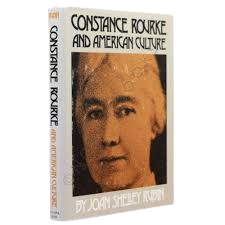
Constance Rourke and American Culture
The career of Constance Rourke (1885-1941) is one of the richest examples of the American writer's search for a ""usable past."" In this first full-length study of Rourke, Joan Shelley Rubin establishes the context for Rourke's defense of American culture -- the controversies that engaged her, the books that influenced her thinking, the premises that lay beneath her vocabulary.
With the aid of Rourke's unpublished papers, the author explores her responses to issues that were compelling for her generation of intellectuals: the critique of America as materialistic and provincial; the demand for native traditions in the arts; the modern understanding of the nature of culture and myth; and the question of a critic's role in a democracy.
Rourke's writings demonstrate that America did not suffer, as Van Wyck Brooks and others had maintained, from a damaging split between ""high-brow"" and ""low-brow"" but was rather a rich, unified culture in which the arts could thrive. Her classic American Humor (1931) and her biographies of Lotta Crabtree, Davy Crockett, Audubon, and Charles Sheeler celebrate the American as mythmaker. To foster what she called the ""possession"" of the national heritage, she used an evocative prose style accessible to a wide audience and depicted the frontier in more abstract terms than did other contempoaray scholars. Her commitment to social reform, acquired in her youth and strengthened at Vassar in the Progressive era, informed her sense of the function of criticism and guided her political activites in the 1930s.
Drawing together Rourke's varied discussions of popular heroes, comic lore, literature, and art, Rubin illuminates the delicate balances and sometimes contradictory arguments underlying Rourke's description of America's cultural patterns. She also analyzes the way Rourke's encounters with the ideas of Van Wyck Brooks, Ruth Benedict, Jane Harrison, Bernard DeVoto, and Lewis Mumford shaped her view of America's achievements and possibilities.
Rourke emerges not simply as a follower of Brooks or as a colleague of De Voto, nor even as an antiquarian or folklorist. Rather, she assumes her own unique and proper place -- as a pioneer who, more than anyone else of her day, boldly and eloquently showed Americans that they had the resources necessary for the future of both art and society. By placing Constance Rourke within the framework of a debate about the nature of American culture, the author makes a notable contribution to American intellectual history.
Originally published in 1980.
A UNC Press Enduring Edition -- UNC Press Enduring Editions use the latest in digital technology to make available again books from our distinguished backlist that were previously out of print. These editions are published unaltered from the original, and are presented in affordable paperback formats, bringing readers both historical and cultural value.
show more
Book Specifications
Book Title
You are viewing an alternative format/edition for this title. You can proceed directly to this book's page to complete your purchase.
More Books By Joan Shelley Rubin
People who bought this also bought

In Command of History: Churchill Fighting and Writing the Second World War book by David Reynolds
Just Mercy: A Story of Justice and Redemption book by Bryan Stevenson
Complete Russian Beginner to Intermediate Course book by Daphne West
All Things New: Bible Study Book: A Study on 2 Corinthians book by Kelly Minter
Inside Steve's Brain: Business Lessons from Steve Jobs, the Man Who Saved Apple book by Leander Kahney
The Power of His Presence: A Year of Devotions From the Writings of Ray Stedman book by Ray C. Stedman
The King James Bible Christianity's Definitive Text Book By Phyllis Corzine
The In Touch Study Series: Discovering Your Identity In Christ book by Charles Stanley
ADHD 2.0: New Science and Essential Strategies for Thriving with Distraction--from Childhood through Adulthood
Reconcilable Differences: Healing For Troubled Marriages book by Jim A. Talley
How to Be a Bawse: A Guide to Conquering Life book by Lilly Singh
Damaged Goods: The Rise and Fall of Sir Philip Green book by Oliver Shah
Behave :The Biology of Humans at Our Best and Worst by Robert M. Sapolsky
Markets and States in Tropical Africa: The Political Basis of Agricultural Policies book by Robert H. Bates
The Third Chimpanzee: The Evolution and Future of the Human Animal book by Jared Diamond
Mossad: The Greatest Missions of the Israeli Secret Service book by Michael Bar-Zohar , Nissim Mishal
Dear Madam President: An Open Letter to the Women Who Will Run the World book by Jennifer Palmieri
The Ascent of Money: A Financial History of the World book by Niall Ferguson
The Success Equation: Untangling Skill and Luck in Business, Sports, and Investing book by Michael J. Mauboussin
Become a Better You: 7 Keys to Improving Your Life Every Day book by Joel Osteen
Speak Like a CEO: Secrets for Commanding Attention and Getting Results book by Suzanne Bates