
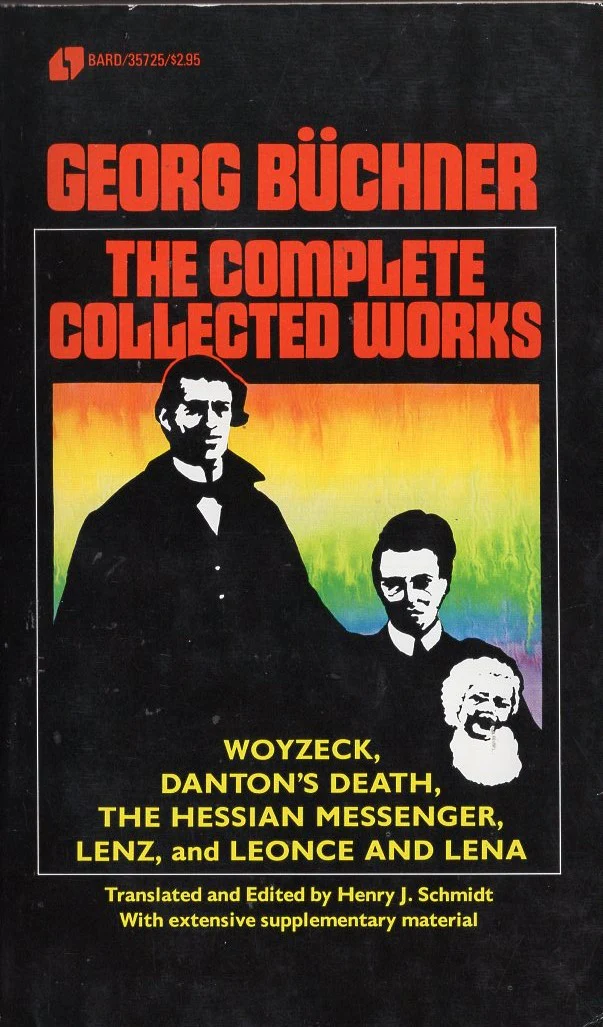
Georg Buchner The Complete Collected Works
By Georg Buchner- Woyzeck
Kaum ein bedeutendes Werk der deutschen Literatur ist in seiner Textfassung so problematisch wie Büchners "Woyzeck". Als Büchner im Februar 1837 starb, hinterließ er ein Konvolut von vier Entwurfshandschriften, deren Text diese Studienausgabe auf drei Stufen wiedergibt: 1. als "Lese- und Bühnenfassung", 2. als "emendierten" Text in der dem dokumentierten Willen des Verfassers möglichst entsprechenden Gestalt mit zusätzlicher Verzeichnung der Textstellen, die Büchner von einer Entwurfsstufe zur nächsten übernahm; und 3. als typographisch "differenzierten" Text, der über den Zustand der Handschrift und über Schwierigkeiten und gravierende Unsicherheiten bei der Entzifferung des Dramentextes informiert. Die vorliegende Ausgabe fußt auf den Vorbereitungen Thomas Michael Mayers zu einer kritischen "Studien- und Leseausgabe nach den Handschriften".
- Danton's Death
Buchner's special quality, and that which makes him seem more contemporary than almost anything written today, is his total, uncompromising honesty of emotion and intellect. The German writer Georg Buchner, who died in 1837 aged 23, left only three works for the theatre. Danton's Death, his great fresco of the French Revolution, was written in five weeks when Buchner was under threat of arrest for his own revolutionary activities. His sad comedy, Leonce and Lena, was composed in haste for a publisher's competition for which it was entered too late. The extraordinary proletarian tragedy Woyzeck was left unfinished at Buchner's death. Virtually unknown until the end of the nineteenth century, the plays have found an important place in the modern international repertory.
- The Hessian Messenger
'The Hessian Courier' ('Der Hessische Landbote'), sometimes referred to as 'The Hessian Messenger' was a political treatise written by Georg Büchner in 1834, with assistance and editing from Friedrich Ludwig Weidig.
- Lenz
Lenz, Georg Büchner’s visionary exploration of an 18th century playwright’s descent into madness, grew in part out of Alsatian pastor Johann Oberlin’s journal, which is translated here in its entirety for the first time. Lenz is a dispassionate account on the nervous system of a schizophrenic, perhaps the first third-person text ever written from the “inside” of insanity. At his death at the age of 23 in 1837, Georg Büchner also left behind Leonce and Lena, Woyzeck, and Danton’s Death—psychologically and politically acute plays well ahead of their time.
Richard Sieburth’s translations include Hölderlin’s Hymns and Fragments, Walter Benjamin’s Moscow Diary, Gérard de Nerval’s Selected Writings and Henri Michaux’s Emergences/Resurgences. His English edition of the Nerval writings won the 2000 PEN Book-of-the-Month-Club Translation Prize.
- Leonce and Lena
Georg Bchner's three surviving dramatic texts show the playwright wrestling with divergent styles in a struggle to convey his bleak worldview. ...Sean Graney reveal[s] much the same process. Both artists want to build on centuries-old theatrical traditions yet shred the niceties of conventional theater to expose life's raw nerves...
...Graney exploits his trademark techniques--stark design, inflated acting, self-reflexive presentation--to create an explosive, richly unpleasant affair....
Bchner poured every ounce of his cynicism into Prince Leonce, whose absurd battle with boredom fuels LEONCE UND LENA. Leonce can find nothing better to do with his days than spit on a rock 365 times in a row, convinced that human beings fall in love, marry, and multiply out of boredom, and finally they die out of boredom.' His childish father has betrothed him to the Princess Lena, a plan that will greatly interfere with Leonce's commitment to idleness.... Since Bchner is satirizing the theatrical conventions of his day, she's earnestly trying to become a fairy-tale princess, spouting poetic rhapsodies about flowers and dragonflies--while wrestling with the realization that there are people who are unhappy, incurably so, simply because they exist.'
For this play Bchner drew heavily on the conventions of commedia dell'arte, then a nearly 300-year-old tradition of stock rustic characters in cartoonish, often ribald situations. Graney transforms the genre into menacing farce, inflating the characters' passions to such volatile extremes that they often quake as though ready to explode."
Justin Hayford, The Chicago Reader
Book details
- Paperback
- 420 pages
- English
- 0380018152
- 9780380018154
About Georg Buchner
georg buchner was Read More about Georg Buchner
More Books By Georg Buchner
People who bought this also bought

The Better Angels of Our Nature: Why Violence Has Declined book by Steven Pinker
Complete Russian Beginner to Intermediate Course book by Daphne West
Presence: Bringing Your Boldest Self to Your Biggest Challenges book by Amy Cuddy
African Dominion: A New History of Empire in Early and Medieval West Africa book by Michael A. Gomez
Crisis in the Horn of Africa: Politics, Piracy and The Threat of Terror book by Peter Woodward
Mother Angelica's Private and Pithy Lessons from the Scriptures book by Raymond Arroyo
This Republic of Suffering: Death and the American Civil War book by Drew Gilpin Faust
Herding Tigers: Be the Leader That Creative People Need book by Todd Henry
City Boy: Chronicles of a Nairobi Life: An Autobiography by Dr Frank Njenga
The Secret Letters of the Monk who Sold His Ferrari book by Robin Sharma
The Pathway to Peace: Walking Daily with Jesus book by Ellen G. White
From Bush to Bush. Journey to Liberty in South Sudan book by Steven Wondu
Rising Strong: How the Ability to Reset Transforms the Way We Live, Love, Parent, and Lead book by Brene Brown
The Blue Sweater: Bridging the Gap Between Rich and Poor in an Interconnected World
Billion Dollar Game: How Three Men Risked It All and Changed the Face of Television book by Peter Bazalgette
The Death of Money: The Coming Collapse of the International Monetary System book by James Rickards
The War of Art: Break Through the Blocks and Win Your Inner Creative Battles book by Steven Pressfield
Paulo Coelho: A Warrior's Life - The Authorized Biography book by Fernando Morais