
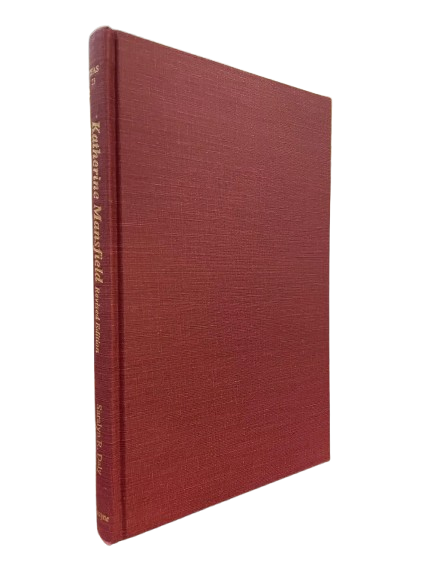
Katherine Mansfield by Saralyn Daly
In this new edition of Katherine Mansfield, Saralyn Daly offers a timely and discerning assessment of one of the century's most gifted writers of the short story. Out of fashion with critics when the first edition was published in 1965, Mansfield has since come to be viewed as a major influence on modernist and contemporary fiction. This revived interest shows itself in various forms; a crop of critical studies, mostly from scholars in her native New Zealand; feminist interpretations of her work; and scholarly editions of her poetry, critical writing, and letters, augmented by a collection of letters between the author and her husband, editor and critic John Middleton Murry. All of these new sources, as well as Daly's close study of early drafts of Mansfield's major stories, inform this book. Mansfield, who died from tuberculosis in 1923 at age 34, wrote often of the inadequacies of personal relationships. She sometimes used her stories to express her feelings to her husband, but his letters exhibit his failure to decode her messages; Mansfield eventually stopped writing her stories "to" or about Murry. This decision, recorded in one of her notebooks, freed her to create her finest work during the last years of her life, beginning with the stories "At the Bay", "The Garden Party", and "The Doll's House" and culminating in "The Daughters of the Late Colonel" and "The Fly". Mansfield introduced most of her character types - abused children, innocent young women and isolated older women, exploited wives, and overbearing husbands - in her earliest short story collection, In a German Pensione. From the very first she wrote from what she knew; her New Zealand youth, the artistic bohemianworld of London, the Continental world in which she convalesced. This choice of subject matter has led biographers to assume her fiction is a direct account of what they perceive to be an unhappy life - an impression that is false, Daly writes, and that was initiated largely by Murry, also Mansfield's literary executor. Mansfield used her memories to compose fiction, but her stories are not literal transcriptions of her experience. In theme, style, and form Mansfield persistently developed her craft. Daly describes the long, painstaking progress that would establish her leadership in short story structure. While Mansfield's stories reflect the spiritual and artistic malaise of her age, they also represent acts of protest and social criticism. Daly's study gives the reader access to a body of work that for this very dissonance remains a cornerstone of the modernist tradition in fiction.
Buy Katherine Mansfield by Saralyn Daly at our website in Nairobi Kenya.
Book Specifications
Book Title
You are viewing an alternative format/edition for this title. You can proceed directly to this book's page to complete your purchase.
More Books By Saralyn Daly
People who bought this also bought

Legacy of Violence: A History of the British Empire book by Caroline Elkins
From Deep State to Islamic State: The Arab Counter-Revolution and its Jihadi Legacy book by Jean-Pierre Filiu
Four Thousand Weeks: Time Management for Mortals book by Oliver Burkeman
Mindset: Changing The Way You think To Fulfil Your Potential book by Carol S. Dweck
Lost History: The Enduring Legacy of Muslim Scientists, Thinkers, and Artists book by Michael Hamilton Morgan
Butter Comes From Butterflies: When I was a kid, I used to believe. . . book by Mat Connolley
Als-Lou Gehrig's Disease (Diseases and People) book by Mary Dodson Wade
Headscarves and Hymens: Why the Middle East Needs a Sexual Revolution book by Mona Eltahawy
Reversing Sail: A History of the African Diaspora book by Michael A. Gomez
Assessment Methods in Recruitment, Selection and Performance: A Manager's Guide book by Robert Edenborough
The Struggle for Land and Justice in Kenya book by Ambreena Manji
Joy at Work: Organizing Your Professional Life book by Marie Kondo