
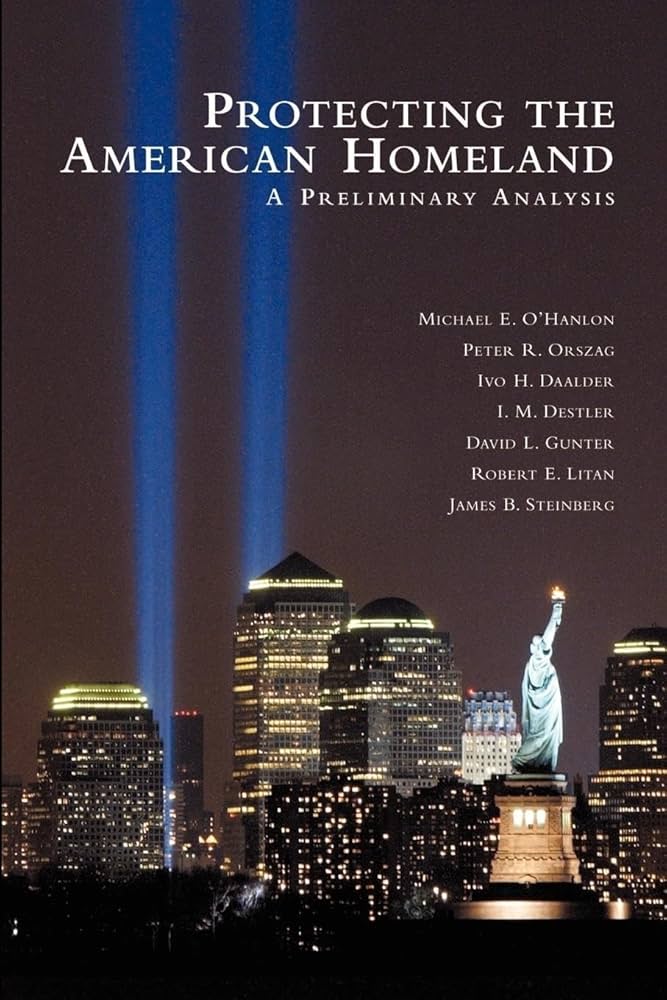
Protecting the American Homeland
By Michael E. O'HanlonThe September 11 attacks forcefully brought home the need to better protect the U.S. homeland. But how can this be accomplished most effectively? Here, a team of Brookings scholars offers a four-tier plan to guide and bolster the efforts under way by the Bush administration and Congress.
There has been some progress in making our homeland more secure. But the authors are concerned that the Bush administration may focus too narrowly on preventing attacks like those of the recent past and believe a broader and more structured approach to ensuring homeland security is needed. Given the vulnerability of our open society, the authors recommend four clear lines of direction. The first and last have received a good deal of attention from the Bush administration, though not yet enough; for the other two, a great deal remains to be done:
- Perimeter defense at the border to prevent entry by potential perpetrators and the weapons and hazardous materials they may use
- Prevention by detecting possible terrorists within the United States and securing dangerous materials they might obtain here
- Identification and defense of key sites within the county: population centers, critical economic assets and infrastructure, and locations of key political or symbolic importance
- Consequence management to give those directly involved in responding to an attack that may nevertheless occur the tools necessary to quickly identify and attack and limit its damage
Included are specific recommendations on how much more to spend on homeland security, how much of the cost should be borne by the private sector, and how to structure the federal government to make the responsible agencies more efficient in addressing security concerns. Specifically, the authors believe that annual federal spending on homeland security may need to grow to about $45 billion, relative to a 2001 level of less than $20 billion and a Bush administration proposed budget for 2003 of $38 billion. They also discuss what burden state, local, and private-sector actors should bear in the overall national effort. Finally, the authors conclude that rather than creating a homeland security superagency, Tom Ridge, the director of the Office of Homeland Security, should have enhanced authority.
Book details
- Paperback
- 188 pages
- English
- 0815706510
- 9780815706519
About Michael E. O'Hanlon
michael edward o'hanlon (born may 16, 1961) is a senior fellow at the brookings institution, specializing in defense and foreign policy issues. he began hi Read More about Michael E. O'Hanlon
More Books By Michael E. O'Hanlon
People who bought this also bought

A Random Walk Down Wall Street: The Time-Tested Strategy for Successful Investing book by Burton G. Malkiel
The Joy of Believing Prayer: Deepen Your Friendship with God book by Joyce Meyer
Living Better: How I Learned to Survive Depression book by Alastair Campbell
An Unquiet Mind: A Memoir of Moods and Madness book by Kay Redfield Jamison
The Difference Maker: Making Your Attitude Your Greatest Asset by John C. Maxwell
Exit Wounds: A Story of Love, Loss and Occasional Wars book by Peter Godwin
Internet Prophets: Enlightened E-Business Strategies for Every Budget
The Almanack of Naval Ravikant: A Guide to Wealth and Happiness book by Eric Jorgenson
Imperial Reckoning: The Untold Story of Britain's Gulag in Kenya book by Caroline Elkins
The Algebra of Wealth: A Simple Formula for Financial Security book by Scott Galloway
The Fifth Discipline Fieldbook: Strategies and Tools for Building a Learning Organization book by Peter M. Senge
Unf*ck Yourself: Get out of your head and into your life book by Gary John Bishop
How to Make Money in Stocks: A Winning System in Good Times and Bad book by William O'Neil
Unsettled: Denial and Belonging Among White Kenyans book by Janet McIntosh
Why Is God Laughing?: The Path to Joy and Spiritual Optimism book by Deepak Chopra
The Anna Anointing: Become a Woman of Boldness, Power and Strength book by Michelle McClain-Walters
Getting Past No: Negotiating in Difficult Situations book by William Ury
Catholicism & Orthodox Christianity (World Religions Series) book by Stephen F. Brown
The Third Wave: Democratization in the Late Twentieth Century book by Samuel P. Huntington
No Matter What!: 9 Steps to Living the Life You Love book by Lisa Nichols