
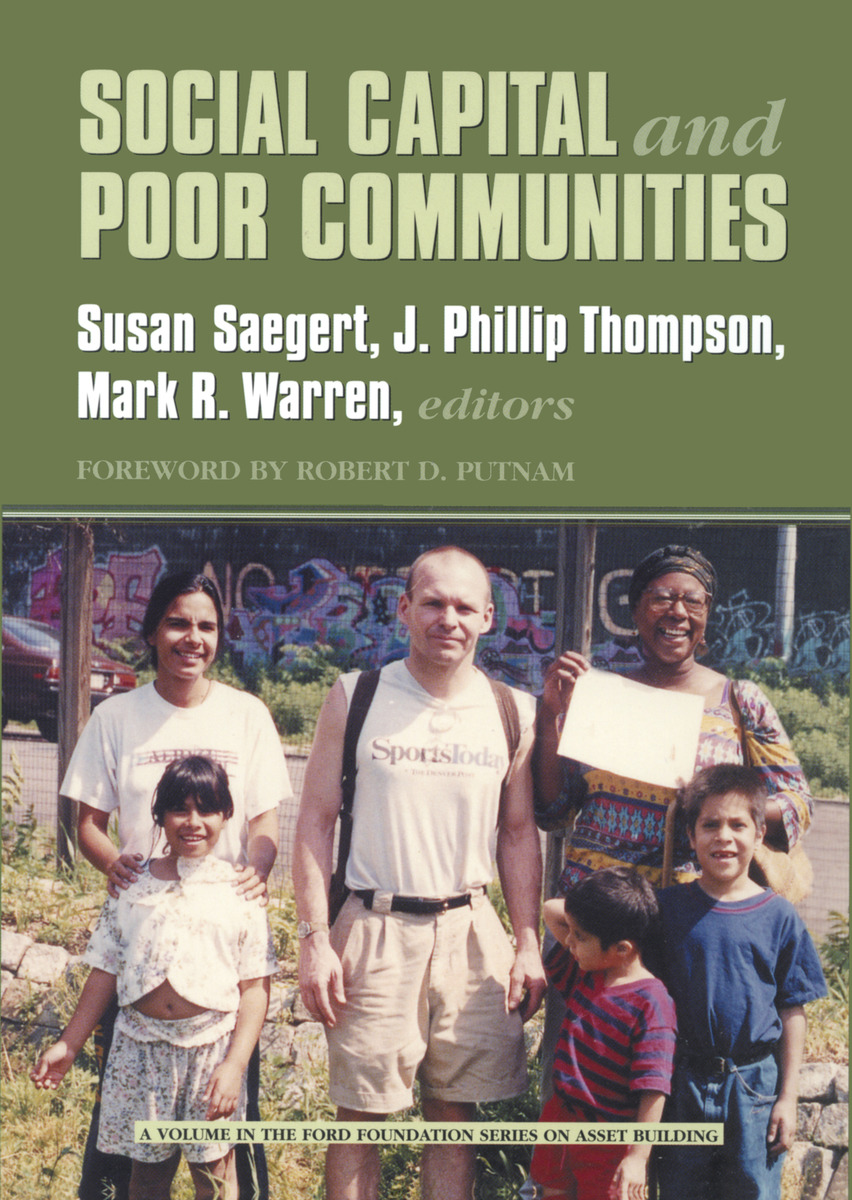
Social Capital and Poor Communities
Neighborhood support groups have always played a key role in helping the poor survive, but combating poverty requires more than simply meeting the needs of day-to-day subsistence. "Social Capital and Poor Communitie"s shows the significant achievements that can be made through collective strategies, which empower the poor to become active partners in revitalizing their neighborhoods. Trust and cooperation among residents and local organizations such as churches, small businesses, and unions form the basis of social capital, which provides access to resources that would otherwise be out of reach to poor families. "Social Capital and Poor Communities" examines civic initiatives that have built affordable housing, fostered small businesses, promoted neighborhood safety, and increased political participation. At the core of each initiative lie local institutions church congregations, parent-teacher groups, tenant associations, and community improvement alliances. The contributors explore how such groups build networks of leaders and followers and how the social power they cultivate can be successfully transferred from smaller goals to broader political advocacy. For example, community-based groups often become platforms for leaders hoping to run for local office. Church-based groups and interfaith organizations can lobby for affordable housing, job training programs, and school improvement. "Social Capital and Poor Communities" convincingly demonstrates why building social capital is so important in enabling the poor to seek greater access to financial resources and public services. As the contributors make clear, this task is neither automatic nor easy. The book's frank discussions of both successes and failures illustrate the pitfalls conflicts of interest, resistance from power elites, and racial exclusion that can threaten even the most promising initiatives. The impressive evidence in this volume offers valuable insights into how goal formation, leadership, and cooperation can be effectively cultivated, resulting in a remarkable force for change and a rich public life even for those communities mired in seemingly hopeless poverty. "A Volume in the Ford Foundation Series on Asset Building" "
show more
Book Specifications
Book Title
You are viewing an alternative format/edition for this title. You can proceed directly to this book's page to complete your purchase.
More Books By Susan Saegert
People who bought this also bought

The Diary of a CEO: The 33 Laws of Business and Life book by Steven Bartlett
How to Be a High School Superstar: A Revolutionary Plan to Get into College by Standing Out book by Cal Newport
The Science of Self-Realization book by A. C. Bhaktivedanta Swami Prabhupada
Love and Respect Workbook: The Love She Most Desires; The Respect He Desperately Needs book by Emmerson Eggerichs
Beyond Success: The 15 Secrets of a Winning Life! book by Brian D. Biro
Heaven Is Real: Lessons on Earthly Joy--From The Man Who Spent 90 Minutes In Heaven
The Founders: The Story of Paypal and the Entrepreneurs Who Shaped Silicon Valley book by Jimmy Soni
The Anxiety and Worry Workbook: The Cognitive Behavioral Solution book by David A. Clark
Change Your Questions, Change Your Life: 10 Powerful Tools for Life and Work book by Marilee G. Adams
Talking to My Daughter: A Brief History of Capitalism book by Yanis Varoufakis
Making It Big: Lessons from a Life in Business book by Femi Otedola
Killing Patton: The Strange Death of World War II's Most Audacious General book by Bill O'Reilly
Saudi Arabia (Countries of the World) book by Dynise Balcavage
Bringing Words to Life: Robust Vocabulary Instruction book by Isabel L. Beck
I Have a Dream: Writings and Speeches That Changed the World book by Martin Luther King