
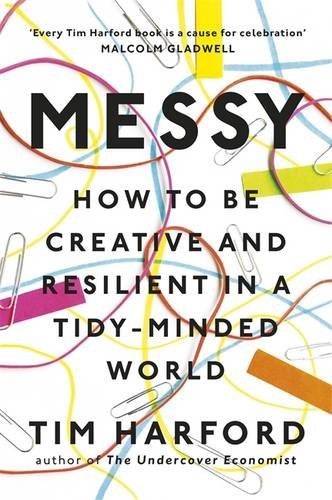
Messy: How to Be Creative and Resilient in a Tidy-Minded World book by Tim Harford
Messy: How to Be Creative and Resilient in a Tidy-Minded World book by Tim Harford
'Ranging expertly across business, politics and the arts, Tim Harford makes a compelling case for the creative benefits of disorganization, improvisation and confusion. His liberating message: you'll be more successful if you stop struggling so hard to plan or control your success. Messy is a deeply researched, endlessly eye-opening adventure in the life-changing magic of not tidying up' Oliver Burkeman The urge to tidiness seems to be rooted deep in the human psyche. Many of us feel threatened by anything that is vague, unplanned, scattered around or hard to describe. We find comfort in having a script to rely on, a system to follow, in being able to categorise and file away. We all benefit from tidy organisation - up to a point. A large library needs a reference system. Global trade needs the shipping container. Scientific collaboration needs measurement units. But the forces of tidiness have marched too far. Corporate middle managers and government bureaucrats have long tended to insist that everything must have a label, a number and a logical place in a logical system. Now that they are armed with computers and serial numbers, there is little to hold this tidy-mindedness in check. It's even spilling into our personal lives, as we corral our children into sanitised play areas or entrust our quest for love to the soulless algorithms of dating websites. Order is imposed when chaos would be more productive. Or if not chaos, then . . . messiness. The trouble with tidiness is that, in excess, it becomes rigid, fragile and sterile. In Messy, Tim Harford reveals how qualities we value more than ever - responsiveness, resilience and creativity - simply cannot be disentangled from the messy soil that produces them. This, then, is a book about the benefits of being messy: messy in our private lives; messy in the office, with piles of paper on the desk and unread spreadsheets; messy in the recording studio, the laboratory or in preparing for an important presentation; and messy in our approach to business, politics and economics, leaving things vague, diverse and uncomfortably made-up-on-the-spot. It's time to rediscover the benefits of a little mess. Published By Abacus on 2018-03
Book Specifications
About Tim Harford
tim harford is a member of the financial times editorial board. his column, “the undercover economist”, which reveals the economic ideas behind
View full author profile →
Book Title
You are viewing an alternative format/edition for this title. You can proceed directly to this book's page to complete your purchase.
More Books By Tim Harford

Messy: How to Be Creative and Resilient in a Tidy-Minded World book by Tim Harford
The Logic of Life: The Rational Economics of an Irrational World book by Tim Harford
Adapt: Why Success Always Starts with Failure book by Tim Harford
The Next Fifty Things that Made the Modern Economy book by Tim Harford
The Undercover Economist Strikes Back: How to Run-or Ruin-an Economy book by Tim Harford
People who bought this also bought
Crisis Investing: Opportunities and Profits in the Coming Great Depression
Artificial Unintelligence: How Computers Misunderstand the World book by Meredith Broussard
Out of Mao's Shadow: The Struggle for the Soul of a New China book by Philip P. Pan
Illness as Metaphor and AIDS and Its Metaphors book by Susan Sontag
Serial Killers: Inside The Minds Of The Most Monstrous Murderers book by Charlotte Greig
The Snowball: Warren Buffett and the Business of Life book by Alice Schroeder
Dare to Be Great!: 7 Steps to Spiritual and Material Riches book by Terry Cole-Whittaker
The Sable and Rosenfeld Elegant Entertaining Cookbook book by Myra Sable
Spies and Commissars: The Early Years of the Russian Revolution book by Robert Service
Reclaiming Development: An Alternative Economic Policy Manual book by Ha-Joon Chang
Valley of the Casbahs: A Journey Across the Moroccan Sahara book by Jeffrey Tayler
The Mystery of Capital: Why Capitalism Triumphs in the West and Fails Everywhere Else book by Hernando de Soto
Over the Top: A Raw Journey to Self-Love book by Jonathan Van Ness
Running on Empty: Overcome Your Childhood Emotional Neglect book by Jonice Webb
The Healthy Christian Life: The Minirth-Meier Clinic Bible Study Guide book by Frank B. Minirth